Lunds universitet, Lunds Tekniska Högskola (LTH)

2nd Circular Building Sector Conference (CBSC 2027)

Lund, Sweden, 19 - 21 September 2027

The 2nd Circular Building Sector Conference (CBSC 2027)

Lund University, Sweden

19 - 21 September 2027

The 2nd Circular Building Sector Conference (CBSC 2027) will take place at Lund University, Sweden, from 19 - 21 September 2027. Organized by the Faculty of Engineering (LTH) and its dedicated profile area Circular Building Sector, the conference provides an international forum bridging cutting-edge academic research with pioneering industrial practice.

LTH Profile Area: Circular Building Sector | LTH, Faculty of Engineering

Transitioning the built environment toward carbon neutrality and resource efficiency requires fundamentally rethinking how materials, assets, and spaces are conceived, assembled, managed, and reused. Contemporary circular building challenges demand holistic approaches: integrating life cycle assessments (LCA) with regenerative frameworks, establishing supply chains and verification for secondary and bio-based materials, creating viable circular business models, and adapting local governance and urban policies. CBSC provides a collaborative platform to critically evaluate emerging methods, experimental testing, policy tools, and real-world demonstration projects across the sector.

Building on the success of the inaugural 2025 conference, CBSC 2027 preserves its signature intimate, walkable format across historic venues in central Lund (including Skissernas Museum and Biskopshuset). The single-track and focused parallel sessions encourage open dialogue, interdisciplinary exchange, and close collaboration among senior researchers, industry practitioners, municipal actors, and doctoral scholars. In addition to peer-reviewed scientific sessions and keynote lectures, the programme includes curated technical site visits and networking events.

The conference is committed to advancing the quality and rigor of circular building scholarship. Papers from conference will be published by E3S web of conferences [with DOI].

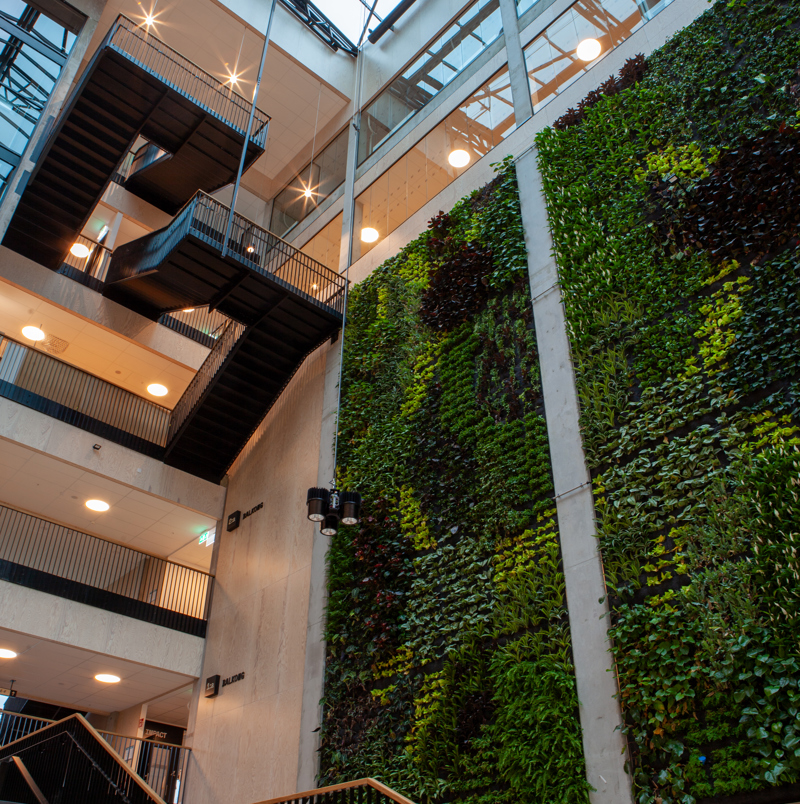
The living green wall in the atrium of The Loop at Lund University

Topics of the Conference

Topics of the conference include, but are not limited to:

Circular Materials and Components

  • Reuse and recertification of precast concrete and structural elements
  • Bio-based, hemp-lime, and circular timber structures
  • Secondary materials, post-consumer wood residues, and recycled aggregates
  • Material passports, digital twins, and material recognition technologies
  • Performance, durability, and mechanical integrity of reassembled components
  • Deconstruction protocols, salvage audits, and non-destructive material evaluation

Circular Design, Buildings, and Adaptive Reuse

  • Design for Disassembly (DfD), versatility, and relocation
  • Architectural heritage transformation and adaptive reuse strategies
  • Building extensions, vertical additions, and modular retrofitting
  • Innovative circular envelope and facade systems
  • Structural frame strategies balancing reclaimed and bio-based components
  • Temporary structures, pop-up architecture, and experimental circular demonstrators

Circular Use, Real Estate, and Business Models

  • Product-Service Systems (PSS) and access-over-ownership models
  • Adaptive property management, flexible leases, and hybrid spaces
  • Addressing vacancy in municipal and regional building stock
  • Neighborhood-scale resharing platforms and social circular strategies
  • Economic feasibility, supply-chain logistics, and cost structures for secondary materials
  • Risk mitigation, warranty models, and insurance for reused building components

Assessment Frameworks, LCA, and Decision Support

  • Whole-life cycle carbon assessments (embodied vs. operational)
  • Circularity metrics, Cradle-to-Cradle (C2C), and 10R framework implementations
  • Scenario planning and multi-criteria decision analysis (MCDA) under uncertainty
  • Material intensity mapping and building-stock level material flow analysis (MFA)
  • Building Information Modelling (BIM) for deconstruction and component tracking
  • Code compliance, standardization, and quality assurance workflows

Governance, Municipal Policy, and Procurement

  • City-led circular transition roadmaps and municipal land-allocation mechanisms
  • Public procurement criteria for reused and recycled materials
  • Regulatory barriers, building codes, and permitting for circular construction
  • Multi-stakeholder ecosystem collaboration and regional circular hubs
  • Social value creation, just transition, and occupant well-being

Circularity in Education and Pedagogy

  • Interdisciplinary curricula across architecture, structural engineering, and economics
  • Hands-on design-build studios, 1:1 prototyping, and testbeds
  • Continuing professional development (CPD) and industry competence building
  • Student-active learning models connecting academic courses to local live projects

3 days

Sessions, site visits and networking

2 venues

Historic venues in central Lund

1 sector

Research, practice and education